Header

Showing posts with label Tangled. Show all posts

Saturday, December 4, 2010

Find out why Rapunzel never had a bad hair day

Rapunzel Lets Her Hair Down in Tangled

Find out why Rapunzel never had a bad hair day in Disney's 50th animated feature and first CG fairy tale.
Posted In | Site Categories: 3DCGFilms
Check out the Tangled trailers, clips and featurettes at AWNtv!
Image
Disney created a whole new hair rendering system based on volume that's a game-changer. Images courtesy of Disney.


Hair has always been treated like a character by Glen Keane: "an outward manifestation" of the character's personality and problem. But Keane and Disney met their match with Rapunzel in Tangled (opening today). With 70-feet of luxurious blond hair, "this is a story about a girl with enormous potential -- she has something inside her that has to get out," Keane explains. "It's physically exploding out of her and is her life force, so the hair has to be compelling…
"[It] has to have rhythm and the way it moves; it has to have volume; it has to have twist; the swoop has to have a definitive shape; and there are a lot of artistic choices for a technical crew that had never been challenged that way before. This wasn't just pushing a button and making sim happen; you've got to also artistically position the hair. It was an amazing team to watch grow. I asked Eric Daniels, who worked with me on Long John Silver doing the mechanical arm, to oversee the hair team to bring artistic qualities into that."
That's because early on hair was treated solely as a technical challenge, so Keane lectured the technical team on the artistic importance, and from then on it became a hybrid solution, like so many aspects of Tangled.
The result is a breakthrough achievement for the way CG hair is rendered, using a blend of simulation and animation techniques to create a new 2D/3D aesthetic in keeping with Keane's vision. So no more worries about touching hair or cloth and out of control collisions.
Image
The plan was to translate Keane's drawings into CG by
breaking down the computer into a digital/analog hybrid.

"I was the liaison between the character TDs and Glen and the directors [Nathan Greno & Byron Howard] to speed up the process and have it look the way they wanted," Daniels suggests. "There were hundreds of parameters that you could tweak and every time the TD would make a change, it would take hours to get the results back. They would have to really think hard: Should I change this and move that a little higher? Make this friction a little lower? Or make the bend frequency a little higher? I can't tell you how collaborative this hair thing has been. It had to be spread across the entire studio. The character animators had to be able to control the hair in a lot of situations, like when she's using it as a whip. But they also had to be able to leave the hair for us. And then the way we would animate the hair would vary from shot to shot."
This necessitated the revamping of the simulation engine developed for Bolt called Dynamic Wires, which added volume, sensuous twists, graceful turns, breaking strands and Rapunzel's trademark swoop in the front. The technical team animated 147 different tubes representing the structure of the hair, which would then be rendered into a final image with up to 140,000 individual strands of hair.
In addition, several new tools were written for hair interaction, motion control and interpolation, volume rendering and a new shading algorithm design to provide more of a real world look to the hair. In fact, they rewrote their RenderMan shader system from scratch. There was even a new hair rig for greater control in animation.
And when Rapunzel's magical hair glowed, that was created by the effects department in collaboration with Look Dev TD Lewis Siegel. The glow was based on an occlusion pass and they also did a fiber-optic effect where light went right down the individual strands and washed through the entire hair. But then that glow had to interact with the characters and environments. The lighting department, for instance, was given a composite graph comprised of effects and animation that was incorporated into its graph. Lighting would also use point clouds combined with hand-placed lights to generate, say, diffuse lighting from the hair onto the characters.

Rapunzel Lets Her Hair Down in Tangled

Find out why Rapunzel never had a bad hair day in Disney's 50th animated feature and first CG fairy tale.
Posted In | Site Categories: 3DCGFilms
Image
Every department touched Rapunzel's hair, thanks to a
new set of shaders and rigs.

"We spent a lot of effort trying to get the physics of the hair -- both the motion and look," says Technical Supervisor Mark Hammel. "We figured if we could get that realistic then we could concentrate on more artistic control. We broke down shading models to have individual shading controls to pull highlights and shadows in ways that depart from reality."
"You put constraints or phantom objects to control the hair in simulation," adds Steve Goldberg, the visual effects supervisor. "One of the first things we worked on was how it fell off her as she walked. They played a lot with the friction on the ground and tangential forces to get the hair follow with her in a believable way."
Kelly Ward, the senior software developer, whose specialty is modeling and simulation, got a head start in improving Dynamic Wires. She was then joined by Maryann Simmons, who concentrated on integration, and Tom Thompson, who worked on the simulation guides and turning them into 100,000 hairs ready for rendering.
"The key to our success on the film was thinking of hair in terms of volume rather than a shell-like surface or individual strands," says Ward.
Image
This attention grabber was the most difficult shot.

Thus, the two main breakthroughs were in the areas of volume transmission (forward scattering) and volume diffuse (backward scattering). The former is particularly important because that pertains to light that enters the hair once, travels through the strands and comes out the other side for backlighting. To achieve these volumetric breakthroughs, they applied techniques of Iman Sadeghi, a UC San Diego grad student, and translated them into a non-ray tracing technique more suitable to a production environment. They could not only render more quickly but also have greater artistic control.
Meanwhile, Hide Yosumi, a character TD, built an animation rig attached to her head as well as a separate prop hair rig in Maya. "We needed to create a new system of keyframe control for the animators," Yosumi suggests. "Then we took that animation and put some simulation on top of it. Not surprisingly, the prop hair rig was used throughout most of the film, when Rapunzel's hair takes on a life of its own, winding its way to a shadowed part of the Tower or another brightly-lit room and then through a field of grass. It required a lot more light and a lot more integration."
The scenes where it was straight simulation were done through draw overs. A few line gestures would be enough to indicate weight and silhouette. There were 173 curves that were simulated or animated.
And what was the most difficult moment to render?
When Rapunzel wraps her hair around the chair with Flynn Rider and slowly moves it. Talk about hair-raising.
COURTESY :Bill Desowitz is senior editor of AWN & VFXWorld.

Rapunzel the Fairy tale

A long time ago, a husband and wife lived happily in a cottage at the edge of a wood. But one day the wife fell ill. She could eat nothing and grew thinner and thinner. The only thing that could cure her, she believed, was a strange herb that grew in the beautiful garden next to their cottage. She begged her husband to find a way into the garden and steal some of this herb, which was called rapunzel.
Now this garden belonged to a wicked witch, who used it to grow herbs for her spells.

One day, she caught the husband creeping into her garden. When he told her what he had come for, the witch gave him some rapunzel, but she made him promise to give her their first-born child in return. The husband agreed, thinking that the witch would soon forget the promise. He took the rapunzel back to his wife, who felt better as soon as she had eaten it.

A year later, a baby girl was born and the witch did come and take her away. She told the couple they would be able to see their daughter in the garden behind their house. Over the years they were able to watch her grow up into a beautiful child, with long fair hair. The witch called her Rapunzel after the plant her father had come to take.

When she was twelve years old, the witch decided to lock Rapunzel up in a high tower in case she tried to run away. The tower had no door or staircase, but Rapunzel was quite happy up there as she could sit at the window watching the life of the forest and talking to the birds. Yet sometimes she would sigh, for she longed to be back in the beautiful garden where she could run and skip in the sunshine. Then she would sing to cheer herself up.

Each day, the witch came to see her, bringing fresh food. She would stand at the bottom of the tower and call out,
"Rapunzel, Rapunzel, let down your long hair."
Rapunzel, whose long golden hair was plaited, would twist it round one of the bars and drop it out of the window, and the witch would climb up it. When she left, Rapunzel would let down her golden hair again, and the witch would slide nimbly down to the ground. One day, the king's son was riding through the forest when he heard Rapunzel singing. Mystified, he rode to the tower, but could see no door, so could not understand how anyone could be there. He decided to stay and watch the tower and listen to the singing. After a while the witch came along and the prince watched her carefully. ° his amazement, as she called out,
"Rapunzel, Rapunzel, let down your long hair," a long golden plait of hair fell almost to the ground.
The prince saw the witch climb up the hair and disappear through the window, and he made up his mind he would wait until she had gone and see if he could do the same.
So after the witch had gone, he stood where the witch had been and called,
"Rapunzel, Rapunzel, let down your long hair."
When the golden plait came tumbling down,
he climbed up as the witch had done and found to his astonishment the most beautiful girl he had ever seen. They talked for a long time and then the prince left, promising to come again. Rapunzel looked forward to his visits, for she had been lonely. He told her all about the world outside her tower, and they fell deeply in love.
One day Rapunzel said to the witch, "Why is it when you climb up my hair you are so heavy? The handsome prince who comes is much lighter than you." At this, the witch flew into a rage and took Rapunzel out of the tower and led her into the forest to a lonely spot and told her she must stay there without food or shelter. The witch cut off Rapunzel's hair and then hurried back to the tower with the long plait of golden hair.
That evening when the prince came by, he called out as usual,
"Rapunzel, Rapunzel, let down your long hair."
The witch, who had secured the plait of golden hair inside the window, threw it down. The prince climbed up eagerly, only to be confronted with the wicked witch. "Aha," she cackled, "so you are the visitor who has been coming to see my little Rapunzel. I will make sure you won't see her again," and she tried to scratch out his eyes.
The prince jumped out of the high window, but was not killed for he landed in a clump of thorny bushes. His face, however, was badly scratched and his eyes hurt so that he could not see, and he stumbled off blindly into the forest.
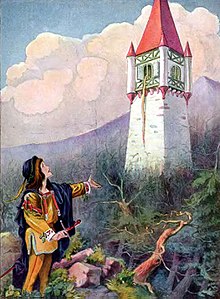
After several days of wandering and suffering, he heard a voice singing. Following the sound. he drew closer and realized he had found Rapunzel, who was singing as she worked to make a home for herself in the forest. He ran towards her, calling her name, and she came and kissed him. As she did so, his eyes were healed and he could see again.
The prince took Rapunzel to his father's palace. where he told his story. Rapunzel was reunited with her parents who were overjoyed to see their daughter again. and a proclamation was made banning the witch from the kingdom. Then a grand wedding took place. Rapunzel married the prince and lived with him for many years. As for the witch. she was never seen again.

"Rapunzel"- The original story

"Rapunzel" is a German fairy tale in the collection assembled by the Brothers Grimm, and first published in 1812 as part of Children's and Household Tales.[1] The Grimm Brothers' story is an adaptation of the fairy tale Persinette by Charlotte-Rose de Caumont de La Forceoriginally published in 1698.[2] Its plot has been used and parodied in various media and its best known line ("Rapunzel, Rapunzel, let down your hair") is an idiom of popular culture


A childless couple that wanted a child lived next to a walled garden which belonged to an enchantress. The wife, as a result of her long-awaited pregnancy, noticed a rapunzel plant (or, in some versions[5] of the story, rampion radishes or lamb's lettuce) planted in the garden and longed for it to the point of death. For two nights, the husband went out and broke into the garden to gather some for her; on the third night, as he was scaling the wall to return home, the enchantress, whose name is said to be "Dame Gothel", caught him and accused him oftheft. He begged for mercy, and the old woman agreed to be lenient, on condition that the then-unborn child be surrendered to her at birth. Desperate, the man agreed. When the girl was born, the enchantress took her and raised her as a ward, naming her Rapunzel. When Rapunzel reached her twelfth year, the enchantress shut her away into a tower in the middle of the woods, with neither stairs nor door, and only one room and one window. When the witch went to visit Rapunzel, she stood beneath the tower and called out:
Rapunzel, Rapunzel, let down your hair, so that I may climb the golden stair.
Rapunzel in the fairy tale garden inLudwigsburgGermany
Upon hearing these words, Rapunzel would wrap her long, fair hair around a hook that sat beside the window and drop it down to the enchantress, who would then climb up the hair to Rapunzel's tower room. A variation on the story also has the enchantress imbued with the power of flight and/or levitation and the young girl unaware of her hair's length.
One day, a prince rode through the forest and heard Rapunzel singing from the tower. Entranced by her ethereal voice, he went to look for the girl and found the tower, but was unable to enter. He then returned often, listening to her beautiful singing, and one day saw Dame Gothel visit, thus learning how to gain access to Rapunzel. When Dame Gothel was gone, he bade Rapunzel let her hair down. When she did this, he climbed up, made her acquaintance, and finally asked her to marry him. Rapunzel agreed.
Together they planned a means of escape, wherein he would come each night (thus avoiding the enchantress who visited her by day), and bring her silk, which Rapunzel would gradually weave into a ladder. Before the plan came to fruition, however, Rapunzel foolishly gave the prince away. In the first edition of Grimm's Fairy Tales, Rapunzel innocently says that her dress is getting tight around her belly; in subsequent editions, she asks the witch (in a moment of forgetfulness) why it was easier for her to draw him up than her.[6] In anger, Dame Gothel cut short Rapunzel's braided hair and cast her out into the wilderness to fend for herself. When the prince called that night, the enchantress let the severed braids down to haul him up. To his horror, he found himself staring at the witch instead of Rapunzel, who was nowhere to be found. When she told him in anger that he would never see Rapunzel again, he leapt from the tower in despair and was blinded by the thorns below. In another version, the witch pushes him and he falls on the thorns, thus becoming blind.
For months he wandered through the wastelands of the country. One day, while Rapunzel sang as she fetched water, the prince heard Rapunzel's voice again, and they were reunited. When they fell into each others' arms, her tears immediately restored his sight. In another variation, it is said that Rapunzel eventually gave birth to two boys (in some variations, a girl and a boy). The prince leads her to his kingdom, where they lived happily ever after. In another version of the story, the ending reveals that the witch untied Rapunzel's braid after the prince leapt from the tower, but it slipped from her hands and landed below the tower. This left the witch trapped in the tower.
The original story came from the story of Rudaba in an ancient Iranian book called Shahnameh, written by Ferdowsi around 1000 AD.[7] Some elements of the fairy tale might also have originally been based upon the legends about Saint Barbara, who was said to have been locked in a tower by her father.[8]

How did Rapunzel become 'Tangled'?

How did Rapunzel become 'Tangled'? Directors Nathan Greno and Byron Howard set the record straight

Categories: Film
Tangled-princessImage Credit: DisneyWhen Disney announced in February that its latest animated movie — a new spin on the Rapunzel story, featuring Mandy Moore as the long-locked princess —  would be calledTangled, fans were confused. Why not just call it Rapunzel, in the tradition of Disney classics like Sleeping Beauty and Snow White? Later, when the movie’sfirst trailer showed a prominent male lead character — the roguish Flynn Ryder (voiced by Zachary Levi) — blogs buzzed with theories that Disney had beefed up the movie’s testosterone level as a reaction to the non-blockbuster box office performance of The Princess and the Frog, which grossed $104 million in 2009. But was that really the case? With the movie out in theaters today, we decided to give Tangled directors Nathan Greno and Byron Howard to grab those rumors by the, er… hair.
ENTERTAINMENT WEEKLY: Your project was originally called Rapunzel. Now it has a different title, Tangled, and a strong male lead. How did that come about? 
NATHAN GRENO: The original intention was to make a film more closely related to something like Cinderella, where your main character is Cinderella, and there’s also a prince that’s in the movie that shows up once in a while. So we started developing: Okay, who is the male character in the show? We started playing around with scenes with our writer, Dan Fogelman, and doing this banter thing back and forth [between Rapunzel and Flynn]. And very early on, without realizing it, we were creating this duo. That’s what eventually lead to the title change. Just as you wouldn’t call Toy Story “Buzz Lightyear,” we really needed a title that represented what the film is, and that it’s a duo, and it stars Rapunzel and Flynn Ryder.
There were rumors that the title change was a somehow a reaction to The Princess and the Frog — that Disney was trying to reposition this as a “boy movie.” Is that true?
BYRON HOWARD: We can honestly say that what you’re seeing on screen in the theaters is exactly what we had about a year ago when Nathan and I talked about changing the title for the first time. I think we really did come to the conclusion that it was about two people, and so it became stranger and stranger to us to just call it by her name. We got about 300 titles listed out. Some of them were really terrible. And the one we kept coming back to was Tangled.
Any of the rejected titles funny enough to share?
BH: Sure. The worst one was The Adventures of Flynn Ryder. [Laughs]
NG: They were mostly lame. And that question keeps coming back to haunt us. And when we see it in print, like “Oh, they changed it to get boys in the theater.” I always just think, boy, I wish we could show them our first screening. It’s been Flynn and Rapunzel, this duo, from our very first screening, which was three or four months into it. We really aren’t trying to fool anybody. We’re just trying to make a great film.

TANGLED

Tangled is a 2010 American animated musical film produced by Walt Disney Animation Studios. The film features the voices of Mandy Moore and Zachary Levi and is the 50th animated feature in the Walt Disney Animated Classics series. The story is largely based on the German fairy tale Rapunzel by the Brothers Grimm. It premiered in theatres and in 3D cinemas on November 24, 2010. To date, it is the most expensive animated film, with a budget estimated to be around $260 million.


Plot
An elderly woman named Gothel witnesses a single ray of sun hit the ground, creating a magical flower with the ability to keep herself young when she sings to it. Centuries later, the queen of a nearby kingdom falls ill while expecting a child. Her guards located the mysterious flower, hidden by Gothel, and bring it to the queen. The flower heals the queen and she gives birth to a girl named Rapunzel, who comes to inherit the flower's magic through her long golden hair. One night, Gothel kidnaps Rapunzel and isolates her in a tower as her own daughter. However, every year on her birthday, the kingdom sends floating lanterns into the sky longing for their lost princess to return.

Eighteen years later, Rapunzel tells Gothel that she wishes to see these annual floating lights that appear on her birthday, but Gothel rejects her by telling Rapunzel that the world is a dangerous place. Meanwhile, the thief Flynn Rider and his twin thugs heist the tiara of the missing princess from the castle. As they flee, Flynn abandons the twins, allowing the pursuing castle guards to capture them. The lead guard's horse, Maximus, is separated from his rider and continues the search for Flynn on his own.

Flynn happens upon Rapunzel's tower to hide in, only to be held captive by Rapunzel and her pet chameleon, Pascal. Rapunzel bargains with Flynn that if he escorts her to the lights and back, she will return the tiara. Flynn agrees as Rapunzel is excited to be free, but is soon conflicted between the elation from the new experience and the guilt of disobedience. Later, Gothel returns to find Rapunzel gone, but finds the tiara hidden in a bag under the stairs.

The pair arrive at the Snuggly Duckling, a seedy pub filled with thugs. However, the thugs recognize Flynn from the poster and plan to turn him in, but Rapunzel confronts the men stating that she needs Flynn to complete her dream of seeing the lights. The thugs decide to help her as they too have unfinished dreams. Gothel watches through a window, but before she can do anything, the royal guards enter and pursue Flynn and Rapunzel to a wooden dam where the two hide in a closed-off cave. Maximus causes the dam to break and the surrounding area and the cave begin to flood. Thinking that they will die, Flynn reveals to Rapunzel that his real name is actually Eugene Fitzherbert, and she explains that her hair glows when she sings. Realizing that it would light the cave, she sings and the cave is illuminated as they swim to a loosened clump of rocks and escape the cave. Meanwhile, Gothel finds the thieving twins and offers them something worth much more than the tiara.

That night, Rapunzel heals Flynn's hand, which was injured in their escape, with her hair and explains that if her hair is cut, it loses its power and turns brown. As Flynn goes to collect firewood, Gothel appears and pleads with Rapunzel to return to the tower, but Rapunzel refuses as she now has a liking for Flynn. Gothel gives Rapunzel the tiara in the bag and says that Flynn is only interested in it and will leave Rapunzel after he gets it. The next morning, Rapunzel forces Maximus to strike a truce with Flynn as the group arrives at the castle for the princess' birthday festival. That evening, Flynn rows Rapunzel out in a small dingy to the middle of an adjacent lake to gain a good view of the lantern release. Rapunzel gives Flynn the tiara saying that she now trusts him. Flynn sees the twins on a different shore and tells Rapunzel that he will be right back. Flynn apologizes to the twins and returns the tiara, but the twins want Rapunzel instead. Moments later, the twins tell Rapunzel that Flynn has abandoned her for the tiara, when in reality the twins have tied Flynn to a boat after knocking him unconscious. However, Gothel betrays them to look like she's rescuing Rapunzel.

Rapunzel returns to her tower room and notices that a flag she collected at the festival looks exactly like the paintings she made all over the tower's interior. The sunburst design is an early memory from her life in the kingdom. Rapunzel realizes that she is the lost princess and confronts Gothel. Meanwhile, Flynn is arrested and is sentenced to be hanged, but is instead rescued by Maximus and the thugs from the Snuggly Duckling. Flynn and Maximus rush to Rapunzel's tower and find Rapunzel held captive by Gothel. Gothel stabs Flynn, but Rapunzel tells Gothel that as long as she lets her heal Flynn, she will go away with Gothel willingly. Since Flynn would rather die than have Rapunzel stay trapped with Gothel, Flynn cuts Rapunzel's hair, causing all of it to lose its power and turn brown. As a result, Gothel quickly ages and falls from the tower, but disintegrates before reaching the ground. Dying, Flynn tells Rapunzel that his dream was her and as Rapunzel cries, her tears suddenly heal Flynn to return to life, overjoying Rapunzel, and leading her to kiss him. Later, Flynn returns Rapunzel to meet her parents and they eventually get married.


——————–
The Grimm yarn of Rapunzel, the girl with the long, golden hair, has been tangled, twisted and extended to get her out of the tower and into the company of a dashing bad boy, musicalized in old-school Broadway fashion and shot through with broad comedy and action rendered in vivid 3D. The Disney name and the studio’s all-powerful promo combined are sure to propel this profitably through the holiday season and beyond, though the question lingers as to the extent of resistance preteen boys will show to this girl-centric romp.

Walt Disney himself pondered an animated Rapunzel feature as far back as the 1940s, and there are two major elements in the film his studio finally has produced that strongly register as Disney trademarks: the flawlessly prettified rendering of nature and the leading characters as well as the incisive portrait of an evil, manipulative villainess. On the more current side of the ledger are the forthrightly adventurous heroine, egregiously present-day phraseology (“Best day ever!”) and the previously unimagined uses to which Rapunzel puts her 70 feet of golden hair, including as a whip and lasso. So shimmering and lush are the girl’s locks that shampoo commercials never will look the same.
Transformed from the original tale’s daughter of poor parents into a princess kidnapped by the scheming Mother Gothel for the power the girl’s golden locks have to keep the woman ageless, the story devised by screenwriter Dan Fogelman (Cars, Bolt) pivots on the tension between Gothel’s need to keep Rapunzel away from the outside world and the yearning of the captive, who’s about to turn 18, to discover it. “When Will My Life Begin?” — the initial musical number from star Disney composer Alan Menken and lyricist Glenn Slater — not only enunciates her desires but shows that, during her youthful isolation, she has been extensively exposed to the arts through reading, painting, music and so on.
Still, given the modern take here, it might have been amusing to acknowledge that growing up in solitary confinement might give a girl some complexes, neuroses and misconceptions about life on the outside. Once she absconds with a dashing thief (not a prince) with the unlikely moniker of Flynn Rider, a bumpy learning curve as to the real world could have provided a bountiful extra layer of humor and behavioral interest.
As it is, the film contents itself with charting the inevitable conversion of Flynn from the charming scoundrel who with two hulking highwaymen types steal the royal crown to a domesticated escort suitable for the daughter of the idyllic realm’s king and queen. Along the way, there is a rollicking encounter in a roadside tavern with a band of ruffians who turn out to be as congenial and musically prone as the seven dwarfs as well as the shenanigans of a comically vigilant white horse, all of which reflects the antic showbizzy approach one associates with John Lasseter, the driving force behind Pixar who now also runs Disney Animation.
Although she is sidelined for significant periods, there still is the determined Mother Gothel to reckon with. One can’t quite put her in the pantheon of evil alongside Snow White’s queen or the Wicked Witch of the West, but she’s a formidable first cousin as she stops at nothing to maintain her hold on her prize. No small part of her power stems from the dynamite performance of Broadway star Donna Murphy, who socks over her dialogue and musical vocalizations with insinuating flair.
In markedly blander roles, Mandy Moore and Zachary Levi do agreeably expressive work with utilitarian dialogue that feels too contemporaneously American and sturdy songs in a throwback style. It’s hard to think of a modern film with a more pristine appearance; every frame looks like it’s just been cleaned and polished by Cinderella herself.
The 3D work is excellent, though the discrepancy in screen brightness between what is seen with and without glasses never has been more pronounced, at least at the screening caught; normally, one can expect the image to dim by 25-30% upon donning 3D shades, but here the light of the film onscreen was cut roughly in half.
source: http://www.hollywoodreporter.com/review/todd-mccarthys-film-review-tangled-42752

Share

Twitter Delicious Facebook Digg Stumbleupon Favorites More